Visit the Abîme de Bramabiau: cave and underground river between Millau and Mont-Aigoual
The Abîme de Bramabiau is a spectacular underground river located at Saint-Sauveur-Camprieu, in the Gard Cévenol, near your campsitenear Millau in Aveyron. This listed natural site in the Cévennes National Park offers a guided tour through the heart of a karstic network where the Rivière du Bonheur disappears underground. The historic cradle of French speleology, the abyss reveals converted galleries and exceptional dinosaur tracks.
L’Abîme de Bramabiau, a listed natural site in Occitanie
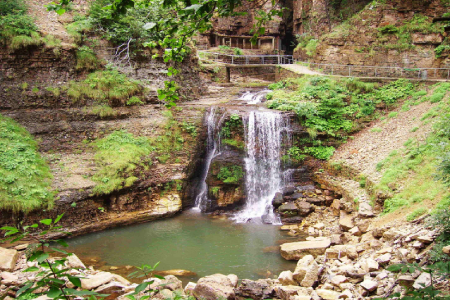
L’Abîme de Bramabiau is located in Saint-Sauveur-Camprieu, in the Gard department, in the heart of the Cévennes National Park. This listed natural site enjoys a privileged position between Mont Aigoual and the Gorges du Tarn. The Rivière du Bonheur rises near the Col de la Serreyrède and flows for five kilometers before disappearing beneath the Causse de Camprieu, only to re-emerge 800 meters further on in a spectacular 70-meter-high diaclase.
The name Bramabiau comes from the Occitan bramabuòu, the bellowing ox, in reference to the roar of a 10-meter waterfall during floods. An unmissable visit, easily accessible from your campsite near the Gard.
What to see on the Abîme de Bramabiau guided tour
The guided tour lasts around an hour and covers one kilometer of the 11 kilometers of galleries explored. Access begins with a 15-minute descent through a beech forest home to over 70 plant species. The underground temperature remains stable at 10°C all year round.
L’Alcôve suddenly appears, with its impressive natural fault from which the river cascades. The route then follows the river on a secure ledge. Visitors discover chaos chambers filled with massive boulders, with conglomerate ceilings and calcite-cemented stones. The exit is via a tunnel built in 2006, ideal for a family visit from your campsite in Aveyron, Gard or Lozère.
The history of French caving at Bramabiau
Édouard-Alfred Martel discovered the Abîme in September 1884. Four years later, he made the first underground crossing with eight companions equipped with canoes and ladders, covering 1,300 meters of unknown galleries. A report to the Camprieu town hall marks the birth of modern speleology.
Félix Mazauric continued his explorations in 1893, extending the network to 6,350 metres. In 1983, three speleologists from Lozère discovered the Félix-Mazauric network, rich in prehistoric remains. Open to the public since 1925, this historic site is well worth a visit on your vacation in the Sud Cévennes.
What to do around L’Abîme: geological heritage and dinosaur footprints
The exit tunnel reveals an exceptional paleontological treasure trove, with dinosaur footprints from the Triassic period discovered in 2005. The karstic network develops in the Liassic dolomites of the Hettangian, while the Bonheur valley follows an ancient fault exploited for its lead, copper, silver and zinc ores.
Granite and limestone intermingle in a remarkable geological arrangement. Classified as a DIREN Occitanie site since 2005, the abyss benefits from scientific and scenic protection, guaranteeing the preservation of the prehistoric network. The Bonheur underground river is the perfect complement to other natural sites in the Cévennes, close to your campsite in the Gorges du Tarn.