7 must-see museums in Aveyron
Aveyron is home to a large number of museums, covering a wide range of themes: fine art, contemporary art, archaeology, insects, crafts and techniques… Here are some of the best-known museums, well worth a visit.
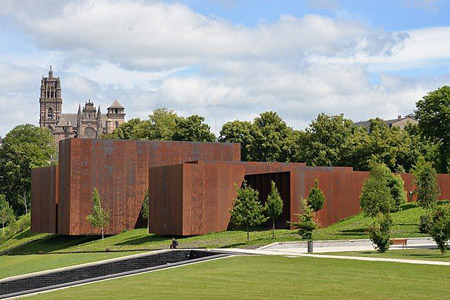
Soulages Museum
Located just a few hundred meters from Rodez Cathedral , in the heart of the Foirail, the Soulages Museum is a fascinating window onto the work of the creator of outrenoir. Inaugurated on May 30, 2014, the museum showcases an impressive collection of paintings by Pierre Soulages, an international figure in contemporary art. Over 500 paintings, drawings, etchings and serigraphs can be admired. The museum is spacious and the aisles are not crowded. A visit with a guide will give you a better understanding of the artist’s pictorial work and his relationship between black and light. https://musee-soulages-rodez.fr
The Denys-Puech Museum
The Musée Denys-Puech, an architectural gem tucked away in the heart of downtown Rodez, houses an extraordinary collection of works, mainly devoted to sculpture, from the mid-19th century to the present day. Inaugurated in 1910, it showcases Aveyron artists, starting with
Fenaille Museum
Also in Rodez, the Musée Fenaille presents the archaeology, art and history of the Rouergue region , the historic name of today’s Aveyron. Housed in a former mansion in old Rodez, the museum sheds light on the earliest traces of man. Sculpture is the main theme of the visit, with over 1,100 objects from the prehistoric era to the 17th century on display on three levels. The Musée Fenaille boasts the largest collection of menhir statues in Europe!
Museum deal: a “coupled” ticket allows you to visit all 3 museums in Rodez for the same price!
The Millau and Grands Causses Museum
The Musée de Millau et des Grands Causses, or Mumig to its friends, takes you on a journey through time, from prehistory to the present day! Housed in the Hôtel de Pégayrolles, right in the center of town, the museum boasts exceptional collections devoted to paleontology, protohistory, Gallo-Roman antiquity and the Middle Ages. Highlights include the remains of the Graufesenque archaeological site , the largest pottery workshop in the Roman Empire in the middle of the 1st century. The museum also presents the history of the Mégisserie and Ganterie of the Grands Causses region . Admission is free. https://mumig.fr/accueil
The Musée du Scaphandre in Espalion
The Musée du Scaphandre is the only museum of its kind in France, and can be visited in Espalion, an essential stop-off point for many tourists on their way to the Lot valley or the Aubrac plateau. Housed in the former Saint-Jean-Baptiste church, the Musée du Scaphandre offers a retrospective of the conquest of the underwater environment from 1797 to the present day. It attracts specialists from all over the world. Over 400 exhibits are on display, including several models of diving suits. On display are the inventions of Benoît Rouquayrol and Auguste Denayrouze, the two Aveyron engineers who invented the self-contained diving suit in 1864.
Micropolis Insect City
On the Lévézou plateau, in the heart of Aveyron, the Micropolis Insect City is a 2,500 m2 space dedicated to the fascinating world of insects. Head for Saint-Léons, birthplace of Jean-Henri Fabre, one of the greatest naturalists of all time. Here you’ll see all kinds of live and naturalized insects, carnivorous plants, a butterfly greenhouse, beehives full of bees and ant hills in full swing. A fascinating museum for children and parents alike!
The Laguiole Knife Museum
In northern Aveyron, in the heart of the Aubrac plateau , the Musée du Couteau de Laguiole introduces you to the history of this world-famous knife and its modern-day cutlers. Enter the cutlery workshops and discover all the stages involved in making a genuine Laguiole knife: preparation of metal parts, forging, sawing, assembly, polishing, chasing, etc. You’ll also discover a fine collection of forged objects and rare, antique Laguiole knives, including the very first knife made in the Aveyron village in the early 19th century: the “Capuchadou”.
photo@Calips/CC BY-SA 3.0/wikimedia/Musée Soulages, Rodez