Where to spot vultures in Aveyron and Lozère?
Make the most of your camping vacation between the Gorges du Tarn and the Jonte to come and meet the vultures of the Grands Causses, in the heart of the Cévennes National Park. The show is guaranteed!
Vultures once again soar over the Causses of Aveyron and Lozère!
After virtually disappearing from our mountains, vultures have made a remarkable comeback since the 1970s. Several species of these protected birds of prey have been reintroduced in the Parc Naturel régional des Grands Causses in southern Aveyron and the Parc National des Cévennes in the Lozère region.
An excursion to the Tarn and Jonte gorges will enable you to meet these unloved yet useful birds, now threatened with extinction.
La randonnée des Vases (Saint Pierre des Tripiers)
In Saint-Pierre-des-Tripiers, between the Gorges du Tarn and La Jonte on the Lozère side, come and observe vultures in their natural environment. The Corniches du Méjan trail features two emblematic rocks of the Causses region: the “Vase de Sèvres” and the “Vase de Chine”, in reference to their evocative shape. These astonishing monoliths have become a major nesting ground for large colonies of vultures. You can clearly see them circling in the Jonte Valley sky, sometimes even a few meters above our heads!
– Departure from Saint-Pierre-des-Tripiers, distance: 7 km, duration: 4 h.
La Maison des Vautours, between Le Rozier and Meyrueis
In Lozère, on the other side of the Causse Méjan, in the heart of the Jonte cliffs, the Maison des Vautours (or Belvédère des Vautours) is a playful discovery and learning center, specially designed to welcome vultures and encourage public observation.
A museum is dedicated to the history of these impressive birds, from their disappearance to their reintroduction to the Causses. A video room shows live footage of the various colonies of vultures nesting along the cliffs. The images are commented on by the site’s ornithologist guides. An observation terrace, equipped with telescopic sights, lets you watch the vultures fly over the Jonte gorges.
– Open: daily in July and August, from 9.15 a.m. to 7.30 p.m., off-season (April, May, June, September, October): from 9.30 a.m. to 6 p.m. and closed on Mondays. Observation outings are organized by the LPO.
– Maison des Vautours, 8150 Le Truel, 48150 Meyrueis (30 km from Les Calquières campsite), tel. 05 65 62 69 69, www.maisondesvautours.fr
Scavengers essential to our ecosystem
The Parc naturel régional des Grands Causses is one of the few sites in France where you can observe all 4 species of European vulture. In small groups, they fly over the Causses like gliders, between 2,000 m and 3,000 m altitude, in warm air currents, in search of food.
Long regarded as birds of ill omen, vultures play a vital ecological role. Essential to our ecosystem, these scavenging birds of prey feed exclusively on the carcasses of dead animals (cows, sheep, goats, etc.).
As nature’s garbage collectors, they help limit the spread of certain diseases (common among gregarious animals such as wild ungulates) and organic pollution of natural environments (lakes, rivers, streams, etc.). Vultures are also very useful to livestock farmers, as they avoid the need for rendering services.
How to recognize the 4 species of vulture?
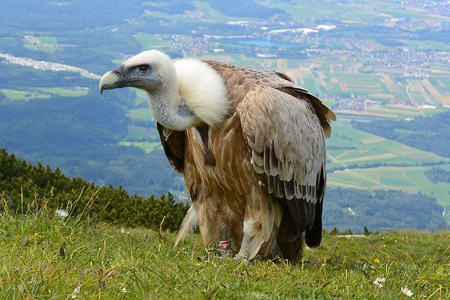
Griffon Vulture (Gyps fulvus): also known as griffon, the Griffon Vulture is one ofEurope’s most endangered species. Its skull is covered with white down, and its neck is long and narrow, adorned with a ruff of bristly white downy feathers. It has a gray beak and yellow eyes.
– Wingspan: 2.40 m to 2.70 m, wings spread
– Weight: 7 to 11 kg
Monk Vulture (Aegypius monachus): owes its name to its dark livery, reminiscent of the black robes worn by monks. Its ruff falls like a hood over its shoulders and its skull is “tonsured”.
– Wingspan: 2.65 m to 2.95 m, wings spread
– Weight: 7 to 10 kg
Egyptian Vulture (Neophron percnopterus): the smallest vulture on the Causses. It can be distinguished from other vultures by its yellow face, long, thin yellow beak and white plumage with black wingtips.
– Wingspan: 1.60 m to 1.80 m, wings spread
– Weight: 2 to 3 kg
Bearded vulture (Gypaetus barbatus): can be recognized by the tuft of feathers growing under its beak, like a black beard. It has broad, pointed wings and a diamond-shaped tail.
– Wingspan: 1.10 m to 1.50 m, wings spread
– Weight: 5 to 7 kg