Discovering the Roquefort cellars in Aveyron
Aveyron is bursting with culinary treasures. Among them, Roquefort is undoubtedly the most famous of Aveyron cheeses. A jewel of French gastronomy, it is even the king of cheeses, with the oldest PDO in France. Which Roquefort winery should you visit? We tell you all about it!
A treasure called Roquefort, Aveyron’s white gold
Roquefort was born in the heart of Aveyron, in the Parc Naturel Régional des Grands Causses. Considered one of France’s oldest cheeses, it is first mentioned in the 11th century. It is even said that the Roquefort cheese tradition dates back to the Rutènes, a Gallic people who settled in the southern Massif Central in the 5th century BC. Julius Caesar, and later Charlemagne, are said to have made it their favorite cheese. In the 18th century, Diderot and d’Alembert dubbed it the “King of cheeses and cheese of Kings”. Two centuries later, in 1925, Roquefort became the first French cheese to receive an appellation d’origine contrôlée (AOC), followed by an appellation d’origine protégée (AOP) in 1996. Now you know what all the fuss is about!
Where is Roquefort cheese made?
This blue-veined cheese, the envy of the world, is made exclusively in Roquefort-sur-Soulzon, a small Aveyron village nestled at the foot of the Rocher du Combalou, in the Grands Causses region. In 1411, Charles VI granted the sole inhabitants of Roquefort a monopoly on maturing the cheese “as practiced from time immemorial in the caves of the said village. ”
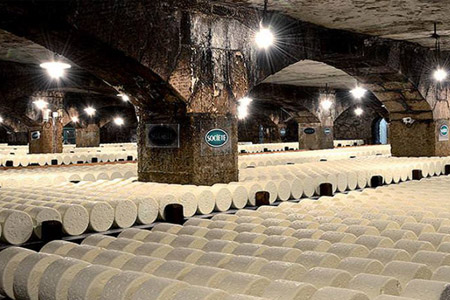
Today, the village of Roquefort-sur-Soulzon boasts 7 producers, all of whom own one or more caves, some of which have been awarded the “Entreprise du Patrimoine Vivant” label. The Roquefort cellars are located in natural cavities formed when the mountain collapsed some 1.5 million years ago. These limestone faults, known as “fleurines”, have been converted into maturing caves. Air circulates in regular currents, and the cellar temperature is maintained at between 8 and 14°, with humidity at 98% – essential conditions for maturing the famous cheese.
Where can you visit the Roquefort cellars?
Make the most of your camping holiday near Roquefort-sur-Soulzon, just 55 kilometers (45 minutes by car) away, to visit the most prestigious maturing cellars for the famous cheese, including :
– Roquefort Société: guided tour of maturing cellars, reconstruction of natural cellar formation, history of Roquefort and free tasting (duration: 1 hour) – www.roquefort-societe.com
– Roquefort Papillon: tour of the cellars, documentary film and tasting of the “Papillon” range of Roquefort cheeses (duration: 1 hour) – www.roquefort-papillon.com
– Roquefort Gabriel Coulet: free tour of the cellars, documentary film, small museum with old photos, free tasting (duration: 1 hour) – www.gabriel-coulet.fr
– Roquefort Combes: better known under the brand name “Le Vieux Berger”, Maison Combes is “since 2012, visit the packaging workshop followed by a projection on the history of the family and the secret of their Roquefort – www.le-vieux-berger.com
– Roquefort La Pastourelle: free tour of the sheepfold, direct sales and Roquefort tasting – www.les-fromageries-occitanes.fr
Direct sales of Roquefort (no visits possible)
– Roquefort Vernières: in love with their craft, Vernières Frères will advise you and help you choose the Roquefort you love – www.roquefort-vernieres.fr
– Roquefort Carles: Direct sales at the packaging and shipping plant – www.roquefort-carles.com
The ideal time to visit the Roquefort cellars is between December and July, when the ewes are nursing. But be careful! It’s around 10°C in the cellars. So don’t forget to bring a little wool!
How is Roquefort cheese made?
Roquefort is made exclusively from the milk of Lacaune ewes grazing on the Aveyron Causses. The sheep’s milk curd is molded and drained for 2 days, before being inoculated with “penicillium roqueforti”. This microscopic fungus gives Roquefort its blue-green veins. The cheese is then removed from the molds and salted for 3 days on one side and 2 days on the other. The cheeses must remain in the cellar for at least 14 days. They are then wrapped in tin foil and stored at low temperatures to slow the development of the fungus. Roquefort continues to mature for a minimum of 90 days in a maturing room. The older it is, the stronger it is! The Roquefort loaves are then unwrapped and cut before final packaging.
photo@ Tourisme Aveyron