By the way, do you know where the name “Les Calquières” campsite comes from?
Les calquières… We’re often asked about the origin of the name of our Aveyron campsite . We give you the answer in this article!
Calç… calçièrs… Calquières
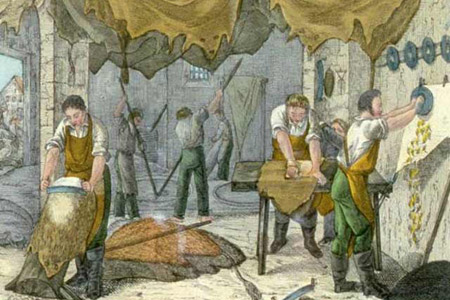
In Languedoc, the term “calquière” refers to the place formerly dedicated to the tanner’s trade. The tanner, also known as blanchier or coyratier, is the person who transforms hides into leather. It’s one of the oldest trades in the world.
The old tanneries or “calquières” originally referred to the pit, vat or washhouse used by the tanner to pound the hides in a lime bath, in order to remove the hair. Lime, known as “cauç” or “calç” in Occitan, was an essential raw material for the tanner. Lime was obtained by calcining (baking) limestone rock in a specially adapted kiln. These lime kilns were also known as “calçièrs”.
Once the animal skins had been dehaired, the tanner immersed them in a pit filled with water and tan, the powdered bark of the holm oak tree, to render the leather rot-proof. Most tanning operations took place outside towns, due to the stench emanating from the tanks where the hides were soaked and washed.
To carry out this water-intensive activity, the Aveyronnais set up their tanning workshops along a river or stream. Take a stroll around Le Monastère-sous-Rodez, Espalion, Saint-Geniez-d’Olt and Millau, and you’re sure to spot houses with wooden balconies along the riverbanks. These are often former tanneries. The animal skins were laid out on the balconies to dry.
Aveyron, a great leather country
In the Grands Causses de l’Aveyron, the abundance of limestone (from which lime is obtained by calcination), the vast oak forests (used to produce tanning tannins) and the numerous flocks of sheep and goats enabled the leather craft industry to flourish from the 14th century onwards. Skins were tanned for use in clothing, footwear, saddlery, leather goods and glove-making. In the mid-18th century, Millau established itself as the capital of leather and glove-making. By the 19th century, leatherworking and the hide trade had become the region’s main economic activity.
Today, the tanneries and megisseries (tanneries specializing in lamb skins) in Millau and the Causses region produce the finest skins for haute couture and the luxury goods industry. Created in 2015, the “Pôle Cuir Aveyron” brings together 19 companies in the leather trades: tanners, tawers, glove makers, leather goods makers, saddlers, boot makers, shoemakers. Among the jewels in Aveyron’s crown is the Pechdo tannery in Millau, one of France’ s last remaining tanneries, along with Arnal’s, established in the heart of the Aveyron region since 1880.
Visit workshops and discover leather professions
Take advantage of your camping vacation near Millau to visit a tannery, a glove factory or a leather factory, and discover leatherworking from every angle.
In Millau, the Causse Gantier factory, a French glove manufacturer founded in 1892 and acquired by Chanel in 2012, offers a behind-the-scenes look at its workshops. Fabre and L’Atelier du Gantier, other masters of the Millau tradition of hand-cut gloves, also offer guided tours of their factories. You can also visit the Gaston Mercier saddlery in Saint-Léons and the Julien H leather workshop in Saint-Georges-de-Luzençon.
Millau and the Grands Causses Museum
In the heart of the old town, the Musée de Millau et des Grands Causses invites you to plunge into the world of leather, gloves and haute couture. It covers all aspects of the megissier trade, from ancient tanning and dyeing traditions to modern techniques for transforming raw, perishable hides into fine, supple, rot-proof skins, and much more. Further information: www.museedemillau.fr